 Technology X Tomorrow's Technology Today!
OPTICAL CONSTRUCTION
The optical construction of this lens makes it so the front element has to extend away from the body to allow for the 24mm-105mm zoom range. It features image stabilization that steadies camera shake at up to 3 stops. It is very impressive as I have been able to successfully shoot at around 1/15th of a second shutter at 105mm with this lens. The IS system does make a little bit of noise when it engages and disengages, but does not make the image jump in the viewfinder as my 15-85mm did.
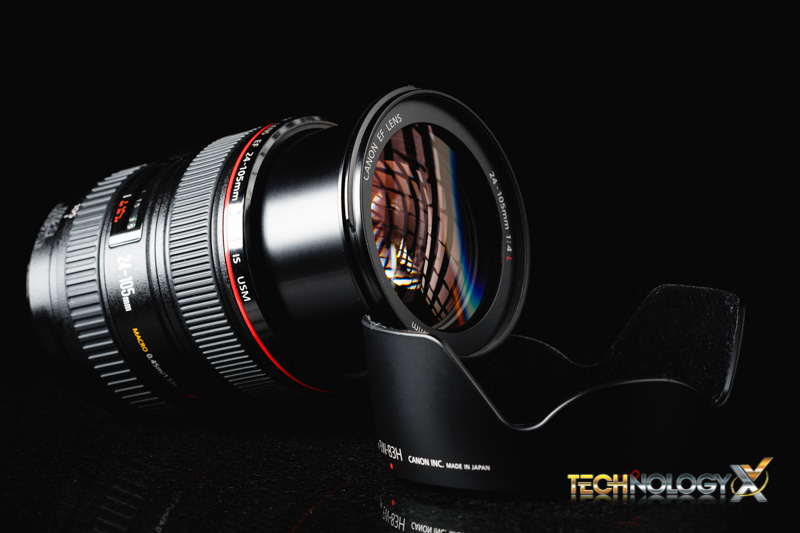
The lens is comprised of 18 elements in 13 groups, in which 1 of the elements are UD glass element and 3 aspherical lenses minimize distortion and chromatic aberration.
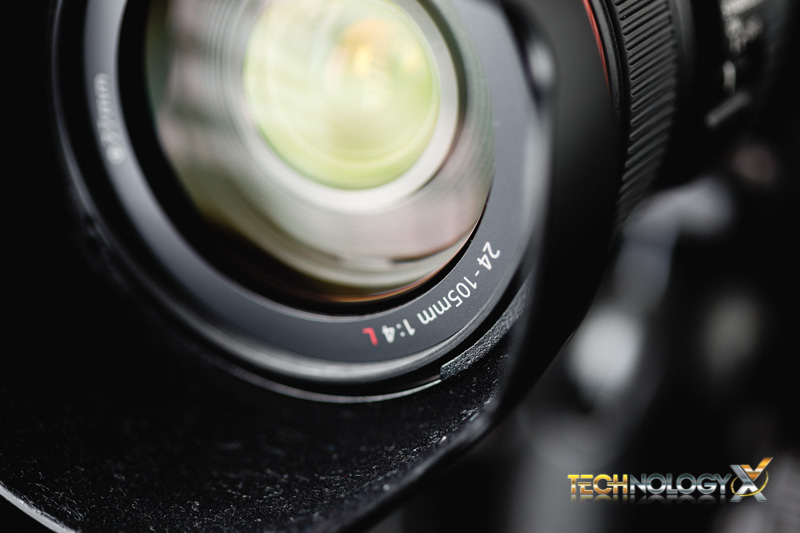
The maximum aperture is f/4. While it is one stop less than its 24-70mm f/2.8 brother, most of the time it’s image stabilization can make up for needing more light. Plus, the image stabilization is great for shooting panning shots or motion shots such as rolling cars. There are also 8 aperture blades to allow for decent bokeh. For best bokeh results you will want to shoot more near the telephoto end at f/4.
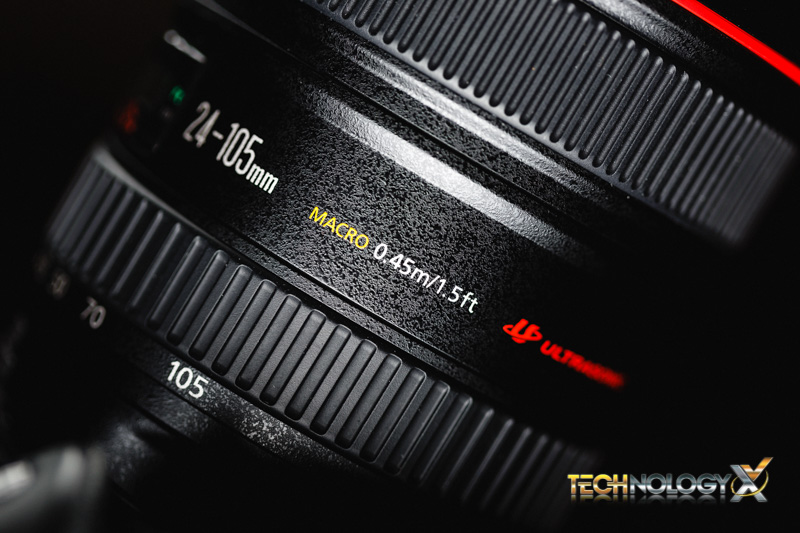
The 24-105mm allows for some macro focusing, the closest focusing distance is .45m or 1.5ft. I find this very useful when using this lens as my walk around lens as I then have the ability to get up close to subjects and get detail shots as I need without being restricted to my dedicated macro lens.
TESTING METHODOLOGY
Equipment wise, for this review I will be using a Canon 60D and Canon 6D bodies. The Canon 60D has an APS-C sensor and the Canon 6D has a full frame sensor. Memory wise we will be using an ADATA XPG 64GB SDXC card. Off camera flash includes multiple Canon 430 EX IIs and Paul C. Buff Ensteins triggered by Pixel King Wireless TTL Flash Triggers or a Paul C. Buff Cyber Commander.
For image quality I will be taking shots in RAW format and post processing them in Adobe Lightroom 5 and/or Adobe Photoshop CC. Images will be exported at 80% quality and 800px in size on the longest edge.
Images will be taken to cover multiple photographic scenarios in order to ensure proper coverage of the lens’s abilities and faults.
GALLERY